Quantum technologies are rapidly moving from theoretical promise to real-world impact, shaping the future of secure communications, computing, sensing and critical infrastructure. According to the Special Report on Quantum Computing published by Netweek (September 2025), Europe is entering a decisive decade for quantum innovation – one in which Greece is emerging as a visible and credible contributor.
At the European level, the new EU Quantum Strategy sets an ambitious goal: to establish Europe as a global leader in quantum technologies by 2030. With an estimated market value of €155 billion by 2040 and thousands of high-skilled jobs expected, the strategy focuses on five pillars: research and innovation, quantum infrastructures, ecosystem development, dual-use and space technologies, and quantum skills. A forthcoming Quantum Act (2026) is expected to further accelerate industrialisation and adoption across Member States.
Within this rapidly evolving landscape, HellasQCI, a project coordinated by the National Infrastructures for Research and Technology – GRNET, operating under the auspices of the Hellenic Ministry of Digital Governance and Artificial Intelligence, with the guidance of the General Secretariat of Telecommunications and Post, plays a key role in positioning Greece within the pan-European EuroQCI initiative.
HellasQCI is the National Quantum Communication Infrastructure of Greece and a cornerstone of Europe’s effort to build quantum-secure connectivity. The project, launched in 2023, is developing a 650 km quantum network spanning Athens, Thessaloniki and Heraklion, interconnecting public authorities, national security bodies, universities and private actors. It combines terrestrial optical fibre links with satellite-based Quantum Key Distribution (QKD) via three Optical Ground Stations (Helmos, Holomontas, Skinakas), while also establishing quantum internet nodes in Athens as testbeds for research and innovation.
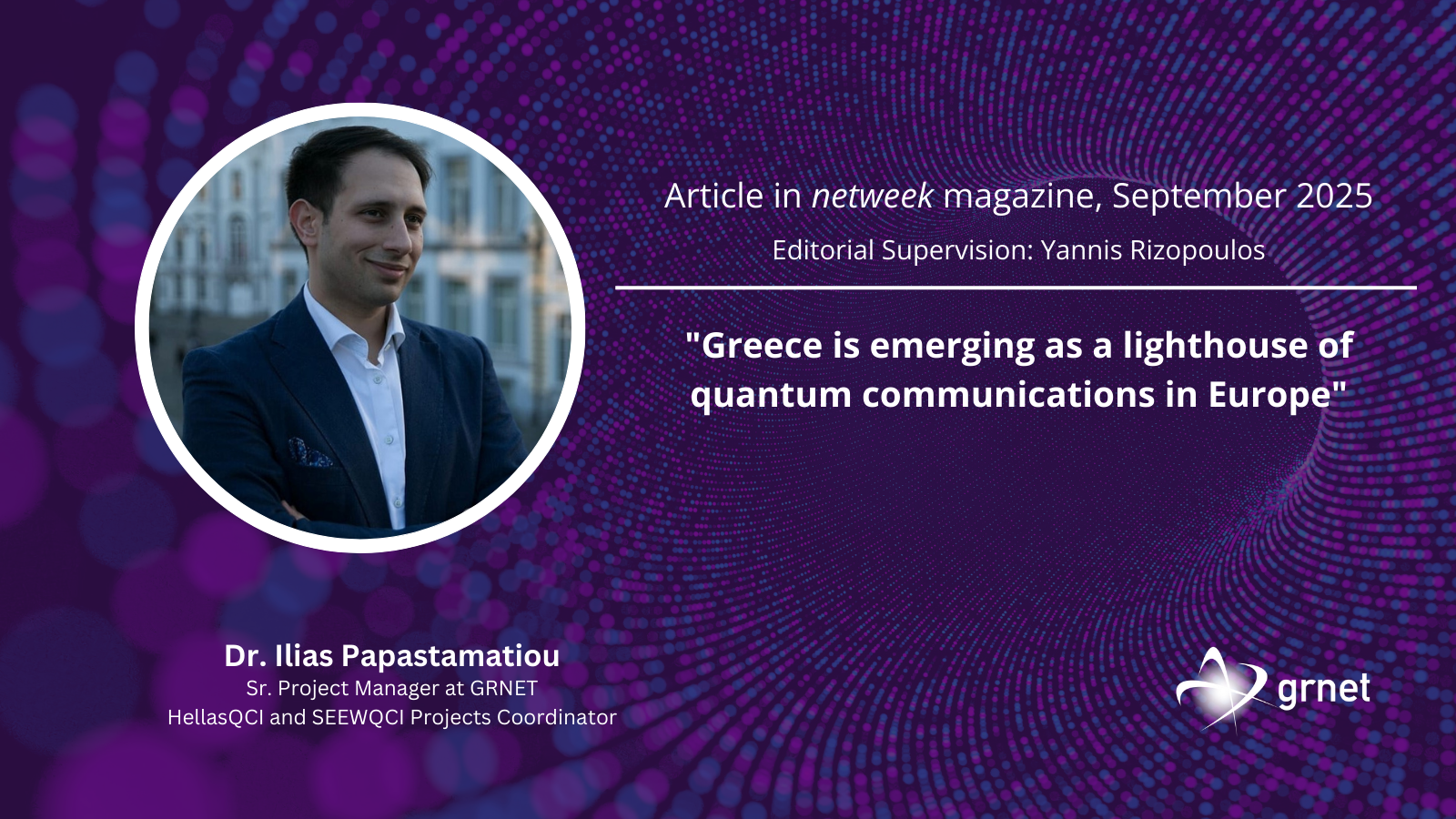
As highlighted in the report, Greece’s role extends beyond national borders. Under the coordination of Dr. Ilias Papastamatiou, Senior Project Manager at GRNET and coordinator of HellasQCI, Greece also leads the new SEEWQCI project. This initiative expands HellasQCI through cross-border connections with Bulgaria, Cyprus and the Netherlands, forming the backbone of an emerging Balkan Quantum Communication Corridor (Greece – Bulgaria) and reinforcing Greece’s emerging status as “a lighthouse of quantum communications in Europe”.
The report also underlines the broader momentum of the Greek quantum ecosystem. Universities, research centres and industry stakeholders are actively contributing to quantum cryptography, post-quantum cryptography, quantum networking and hybrid security models. Greece has already demonstrated practical leadership, notably during QCI Days Athens 2025, where a full, real-time interoperability demo of a multinational quantum network was presented for the first time in Europe.
Looking ahead, the priorities are clear: expansion of the national infrastructure, strengthening skills and education, ensuring interoperability with European networks, and translating pilot deployments into sustainable services for public administration, energy, health, finance and defence. As the Special Report concludes, quantum technologies are not a distant vision – they are a strategic imperative, and Greece, through HellasQC, is actively shaping their future in Europe.
Read the full Special Report on Quantum Computing here.

