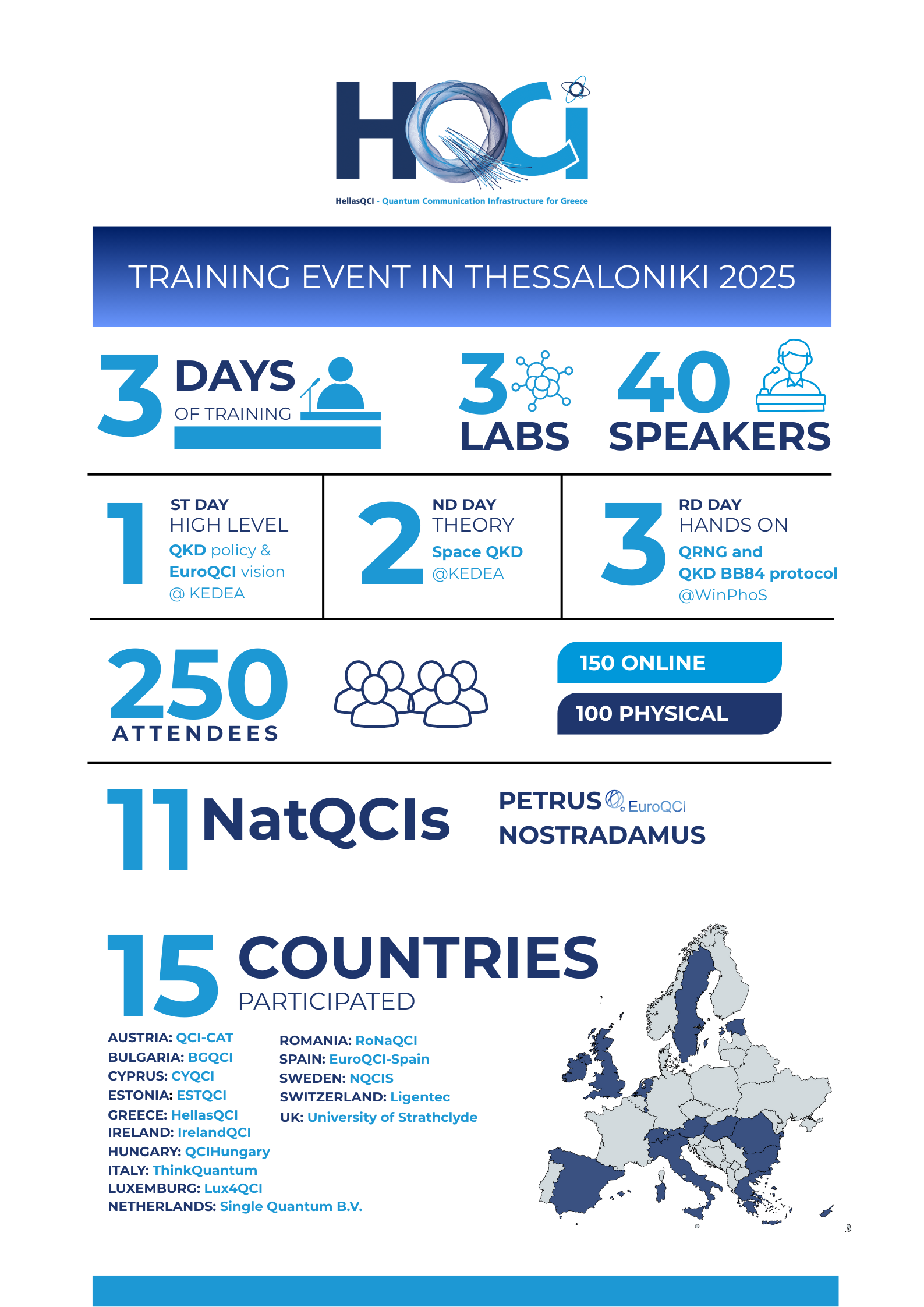
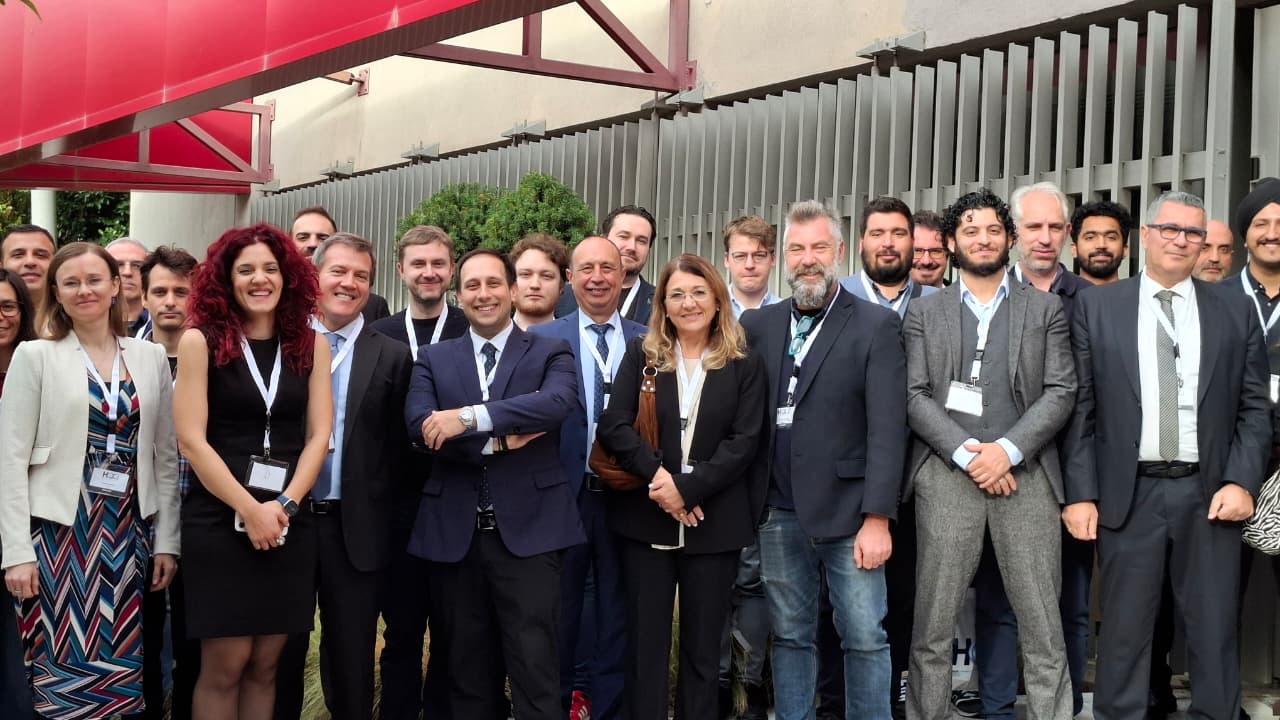
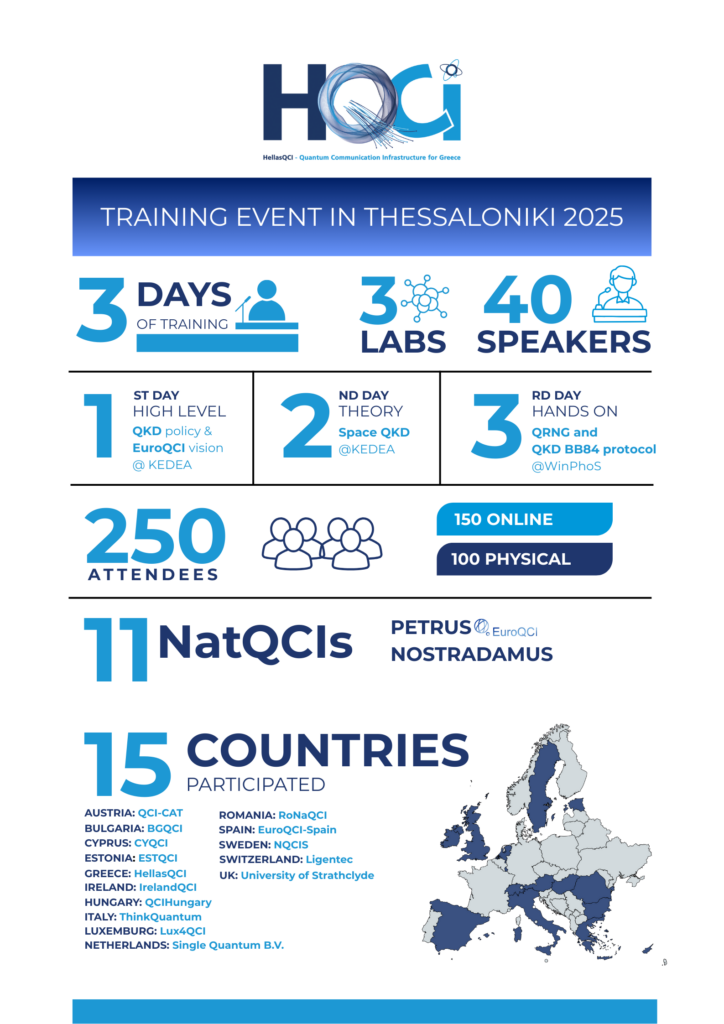
In total, 15 countries were represented, reflecting the strong pan-European dimension of the event and its alignment with EuroQCI objectives. The training was executed through a hybrid format, leveraging modern conferencing infrastructure for remote access while maintaining high-quality in-person sessions, laboratories, and demonstrations. This approach ensured effective knowledge transfer, active participation, and meaningful networking across national and disciplinary boundaries.
Overall, the event was executed in a structured, efficient, and impactful manner, reinforcing HellasQCI’s role as a national and European hub for quantum communications training and contributing directly to workforce development, interoperability, and ecosystem building within the EuroQCI framework.
Thematic Content
Day 1 – High-Level QKD Policy and EuroQCI Vision (26 November 2025, KEDEA)
The first day of the HellasQCI Winter School focused on the strategic, policy, and ecosystem dimensions of Quantum Key Distribution (QKD) and the EuroQCI initiative. The training opened with welcome remarks from representatives of the Ministry of Digital Governance and AI (MinDigital), Aristotle University of Thessaloniki (AUTH), GRNET, KETYAK, and the Hellenic Space Center (HSC), highlighting the national importance of quantum-secure communications for public administration, national security, research, and space applications. An overview of the three-day programme was provided by AUTH, followed by a keynote lecture from the University of Strathclyde, setting the scientific and technological context for quantum communications in Europe, and a presentation by NKUA on HellasQCI’s participation in flagship EuroQCI demonstrations (QCI Days 2025 and ECOC 2025).
The programme continued with an overview of the PETRUS and NOSTRADAMUS projects, presented by Deutsche Telekom, illustrating how large-scale European initiatives contribute to interoperability, validation, and industrialisation of QKD technologies. A dedicated panel on National Quantum Communication Infrastructures (NatQCIs) brought together representatives from HellasQCI (GRNET), Lux4QCI (University of Luxembourg – SnT), CYQCI (Cyprus University of Technology), BGQCI (Teleconsult EOOD, Bulgaria), and IrelandQCI (Walton Institute, SETU), providing a comparative overview of national deployment strategies and cross-border collaboration. In the afternoon, a second NatQCI panel included contributions from QCI-CAT from Austria (AIT), EuroQCI Spain (ICFO), EstQCI from Estonia (RIKS), NQCIS from Sweden (Stockholm University), QCIHungary (KIFÜ) and RoNaQCI from Romania (University Politehnica of Bucharest), underlining the pan-European dimension of EuroQCI.
The day concluded with an industrial QKD session featuring European technology providers and integrators, including ThinkQuantum, Zero Third, Nokia, Single Quantum, QRBIT, and QUBITECH, offering insights into commercially available QKD systems, components, and deployment challenges, followed by a networking reception.
Day 2 – Theory for Space QKD and Optical Ground Stations (27 November 2025, KEDEA)
The second day was dedicated to the theoretical and technological foundations of space-based QKD and optical communications. The programme began with an introduction to quantum information theory by AUTH, followed by sessions on space-based QKD architectures and satellite QKD systems delivered by QRBIT and the Photon and Communication Research Laboratory (PCRL). A comprehensive tutorial on satellite QKD using the QuantLink platform provided participants with an in-depth understanding of end-to-end space quantum links.
Subsequent sessions focused on enabling technologies for space quantum communications, including superconducting nanowire single-photon detectors (SNSPDs) by Single Quantum, photonic integrated circuits (PICs) by Ligentec, optical communication technologies through HellasSat, and the GreekObs2OGS initiative presented by Raymetrics. Industrial and space-sector contributions continued with presentations on miniaturised VCSEL and PIC transceivers for inter-satellite optical links by LEO Space, as well as the PeakSat optical CubeSat mission by the AUTH CubeSat Team.
The afternoon sessions highlighted Greece’s Optical Ground Stations (OGSs), with detailed presentations of Holomontas (AUTH), Helmos (National Observatory of Athens), and Skinakas (FORTH / University of Crete), demonstrating their role within HellasQCI and the broader EuroQCI space segment. The day concluded with sessions on quantum random number generators (QRNGs) for space QKD, hands-on experiment theory, and a practical demonstration of the DV-QKD BB84 protocol and a two-bit quantum computer by NTUA and QGreece.
Live QKD Demonstration (26-27 November 2025, KEDEA)
During the first two days of the event, NKUA operated a live Quantum Key Distribution demonstration aimed at participants who were not already familiar with QKD concepts. The demo featured two QKD links arranged in a relay configuration, forming three interconnected QKD nodes. At each node, a FortiGate firewall consumed QKD-generated keys to establish IPsec VPN tunnels, enabling a three-way, quantum-secure videoconference. This setup allowed attendees to directly observe the operation of a QKD-enabled network and to engage with the NKUA team for detailed explanations of both the underlying principles and the practical integration of QKD with standard network security technologies.
Day 3 – Hands-On QKD Training and Demonstrations (28 November 2025, KEDEK & NOESIS)
The third day focused on applied, hands-on training, allowing participants to directly engage with QKD technologies and operational concepts. Structured laboratory sessions on the building blocks of QKD were conducted in three consecutive modules, guiding participants through practical aspects of QKD system operation, photon-based QKD protocols, and experimental setups. These sessions were designed to reinforce theoretical knowledge acquired during the previous days and to develop operational competence in quantum-secured communications.
The training concluded with a live satellite tracking demonstration at NOESIS, linking the hands-on QKD exercises with real-world space communication scenarios and underlining the importance of integrating terrestrial and space-based quantum infrastructures within HellasQCI and EuroQCI.
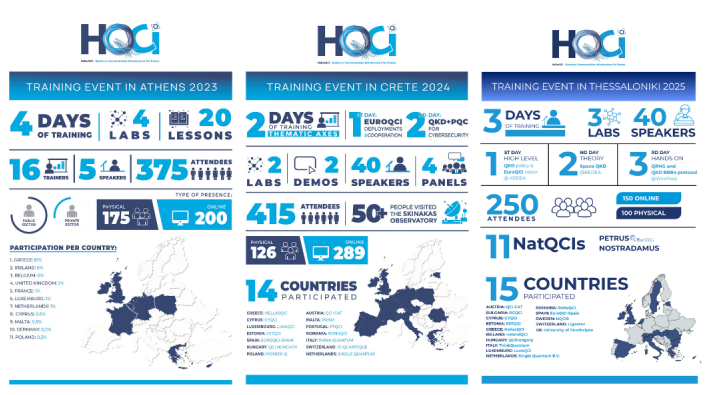
Cumulative Training Impact (2023–2025)
- Total Attendees: 1,040+ professionals trained
- Total Lessons: 75 training modules delivered
- Total Laboratory Sessions: 9 hands-on labs conducted
- International Engagement: Training spanning 3 Greek cities and 15+ countries
- Recurring Partners: PETRUS CSA, Nostradamus, and 20+ NatQCI projects demonstrating sustained EuroQCI ecosystem engagement
- Training Platform Users: 124
- HellasQCI Community Registry: 37 Members
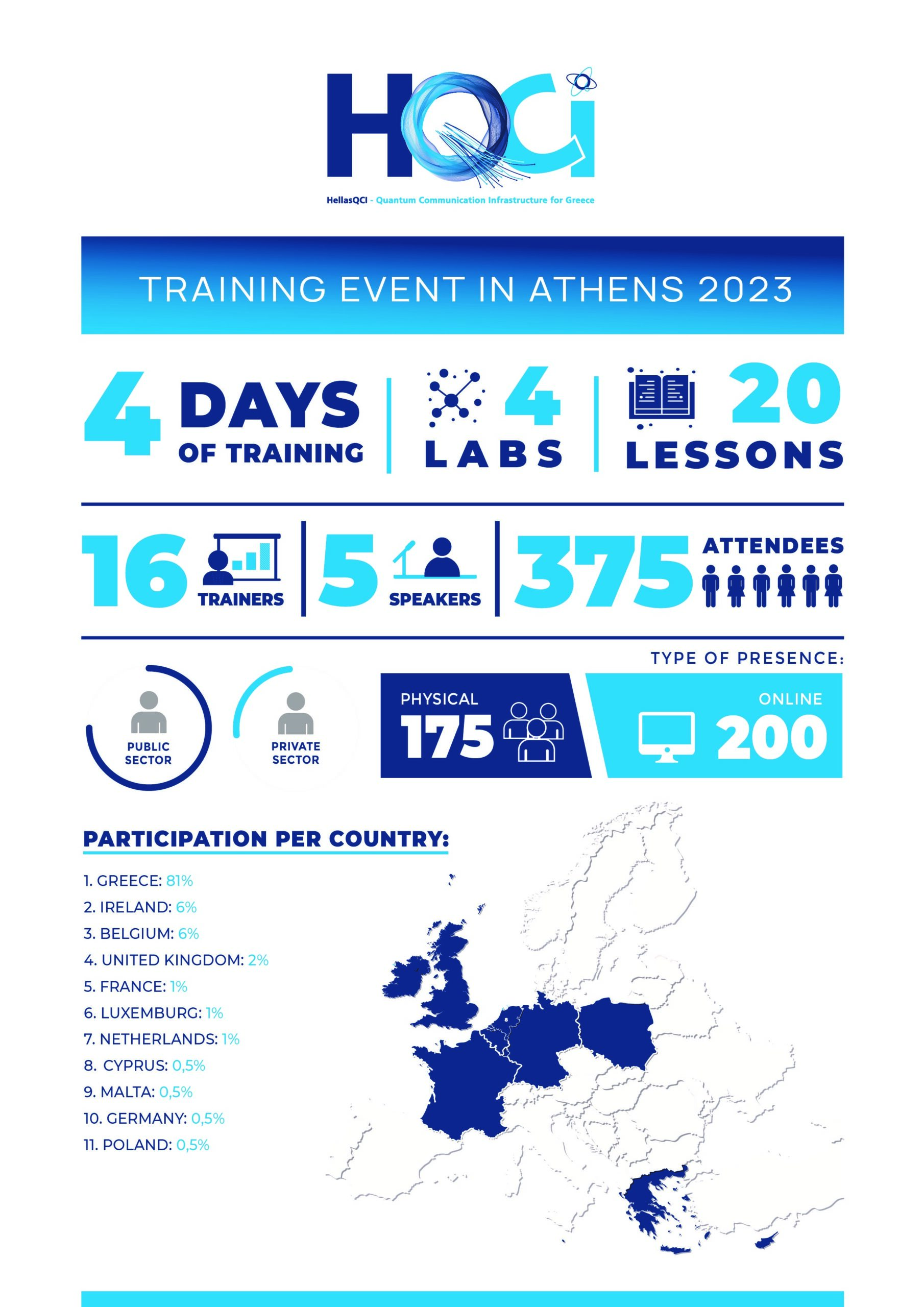
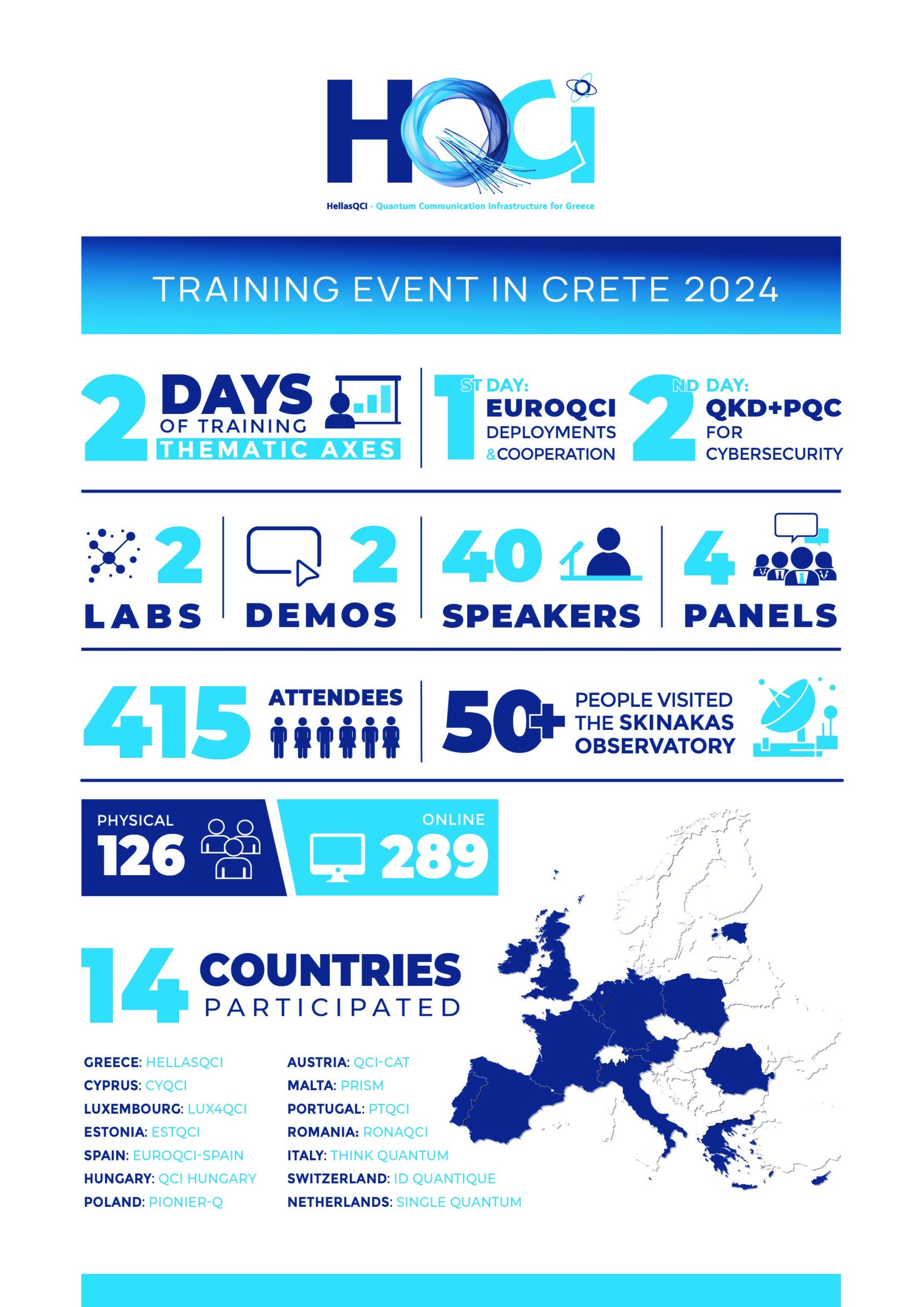
Infographics of Training Events – Athens 2023 – Crete 2024 – Thessaloniki 2025
Useful Links & References
Official Project Websites
- HellasQCI Project Portal: https://hellasqci.eu/
- HellasQCI Training Platform: https://training.hellasqci.eu/
- HellasQCI Winter School Agenda: https://hellasqci.eu/hellasqci-winter-school-2025/
- GRNET – National Infrastructures for Research and Technology: https://www.grnet.gr/
EuroQCI Framework & Documentation
- EuroQCI Initiative: https://petrus-euroqci.eu/
- Digital Europe Programme https://digital-strategy.ec.europa.eu/
Winter School Video & Media
- Event Highlights [Available on HellasQCI YouTube Account here]
- Diavlos Webstream On demand here
- Download full report here